Challenge the Narrative: Extinguishing the Flames of Oppression in Kashmir

As St. Olaf students, we fight for human rights, and this often means speaking truth to power. When institutions of power deliver a resounding victory for human rights, how do we react? How do we ensure we’re not unwitting participants in rhetoric and protests that undermine the principles we uphold?

And how do we protect ourselves from being swept away by false headlines? 

JK
Kashmir.

This is the question we must answer with the current narrative surrounding Kashmir. At a handful of events on campus, specifically those sponsored by the Political Awareness Committee and Celebrate South Asia, you might have heard any number of things regarding the balance of social and political power in Kashmir.

With sufficient context, however, it becomes clear that this isn’t the whole story.

The Kashmir region actually refers to three areas in Northern India – Jammu, Kashmir, and Ladakh. Kashmir is the most powerful of the three. Additionally, each region is different: Jammu is Hindu-majority, Kashmir valley is Muslim-majority, and Ladakh is half Buddhist.

Kashmir Map

Following the British withdrawal from India in 1947 after centuries of colonial subjugation, the nation was split into two – India and Pakistan. Nearby kingdoms had to choose which country to join: secular India or Islamic Pakistan. As the ruler of the Kashmir region deliberated, Pakistan invaded. In response, the king asked India for help, images.jpgsigning a formal treaty of accession to join India and asking India’s help to drive out the Pakistani troops. The prime minister of India, Jawaharlal Nehru, appealed to the United Nations, who suggested a popular referendum if Pakistan removed their troops. Decades later, the soldiers remain, and no referendum has occurred.

You may have heard references to “Pakistan-administered” Kashmir, or that Kashmir is claimed equally by Pakistan and India. Suppose the U.S. Army marched into Ontario and declared it a U.S. territory; Ontario wouldn’t simply become “U.S.-administered”. Similarly, Pakistan has no legal claim on Kashmir. Just as Ontario is an integral part of Canada, Kashmir always has been and always will be an integral part of India.

For the Kashmir region, two laws were enacted. The first, Article 370, limited the central government’s control over legislative issues in Kashmir. In 1954, a further law, Article 35A, allowed the region to privilege those it deemed “permanent residents”. This allowed the Kashmiri legislature to deny basic civil rights to non-residents — which include those that follow.

  • Under Indian law, women cannot be penalized for marrying someone from another state. By the Articles, if a Kashmiri man marries a non-Kashmiri woman, she and their children gain resident status; but if a Kashmiri woman marries a non-Kashmiri man, she and their children forfeit this status.
  • Under Indian law, Muslim women are protected from the archaic practice of “triple Talaq,” where a man can say the words “talaq talaq talaq” to instantly divorce his wife. By the Articles, this practice remains legal in Kashmir.
  • Under Indian law, historically disenfranchised groups have access to one of the largest affirmative action programs in the world for educational, political, and economic opportunities. By the Articles, in Kashmir, these citizens are confined to menial labor such as sweeping or latrine maintenance with zero possibility of social or economic mobility. Radhika Gill, a 19-year-old girl, and her family belong to this community. She passed the border security force entrance exam and is a top athlete, potentially giving her access to opportunities that would allow her to lift herself and her family out of poverty. Unfortunately, by the Articles, she can work only as a sweeper.
  • Under Indian law, children have the right to an education and cannot be married. By the Articles, Kashmiri children lack this right and are not protected from child marriage.
  • Under Indian law, homosexuality is not a crime, and ‘non-binary’ is recognized as a gender identity. By the Articles, these protections do not apply in Kashmir.
  • Under Indian law, agencies have been set up to combat government corruption. By the Articles, anti-corruption laws did not apply to Kashmir and these agencies were forbidden from conducting investigations there.
  • Under Indian law, a tier of governance exists at the level of villages – similar to a city council. These political units are officially recognized by the central government and have protections to ensure free and fair elections. This model places local decision-making in the hands of local people and has empowered women across the rural heartland to develop independence and self-sufficiency. By the Articles, this model did not apply to Kashmir.

On August 5, 2019, the Indian government nullified Articles 35A and 370 via a presidential order and a vote in India’s legislature.

In attempting to address terrorist threats in the region, ordinary Kashmiris have been caught in the middle. After the Articles were removed, there was a temporary blackout of landlines and mobile services in Kashmir. Though drastic, it was a necessary step in order to prevent organized terrorist activity (which relies on these technologies) in the immediate aftermath. A few weeks later, schools, markets, and other public facilities were freely open again.

Landlines are now working. Mobile services are working in all but eight districts – districts in the Valley known to have active terror networks.

83344e0fa8d9f2d4aa298344d37c2341.jpg

Though many have claimed that key hospital facilities were shut down due to the revocation of Article 370, Aarti Tikoo Singh, senior assistant editor with the Times of India,  conducted an extensive series of interviews with hospital administrators and doctors in the area. They expressed concern about false reporting on the state of medical facilities, responding that for the last thirty years, hospitals have been well-equipped to deal with crisis situations such as this – for example, when a major terrorist leader was killed, rioters shut down the whole valley for months, but not one hospital failed to function.

There have been a handful of protests, which many news outlets have eagerly compared to the pro-democracy demonstrations in Hong Kong and other parts of the world. These protests, however, feature flags of Jaish-e-Mohammed, Lakshar-e-Taiba, and ISIS, terrorist groups condemned by the US, EU, and India. In addition, the protests have featured chants of the name “Burhan Wani”, the leader of al-Qaeda in Kashmir killed in 2016. While there has been heinous behavior by some Indian security forces (that must be brought to light and roundly condemned), it has been quite uncommon and not nearly to the extent as what is being reported; video evidence proves that the majority of violent protests are being met with a nonviolent police response.

Strangely, the debate over Kashmir’s status seems to omit the 1990 ethnic cleansing of Hindus, where over 400,000 natives were tortured, raped, killed, and driven from their homes by insurgents sponsored by Pakistani intelligence. Hindu families received written notices that read,

Hindu Home Ruins
Ruins of a home once owned by a family of Kashmiri Hindus.


“This land is only for Muslims, and is the land of Allah. Sikhs and Hindus cannot stay here. If you do not obey,
we will start with your children.”

Over 30,000 homes, businesses, and places of worship were vandalized, occupied, or destroyed. An entire population of indigenous people was erased, and those responsible now occupy their stolen land. The removal of the Articles offers these refugees the chance to return to their homes.

When we fight for the rights of the oppressed, we must be willing to follow that struggle where it takes us. We cannot advocate for one persecuted group and willfully ignore another simply because it’s convenient to do so. The only people who benefited from Articles 370 and 35A were powerful Sunni Muslim men: a local heteronormative patriarchy. And thus, the removal of these discriminatory laws means equal protection under the law, for everyone, regardless of religion. 

Some students on campus say that Kashmir is burning. I contend that the fires of oppression — of misogyny, homophobia, transphobia, classism, and genocide — have just begun to be extinguished. Rather than being swept away by misleading rhetoric, we have the power to confront the dominant narrative, to seek an understanding based on reason and context, and to listen for the stories that aren’t being told.

On Holi and Hinduism

Religion. For better or worse, it remains a deeply influential element of our society, both here in the United States and in other countries around the world. Faith-based systems provide us a framework for self-improvement: to work to better ourselves and our fellow humans.

I would argue that legitimate criticism of the negative aspects of religion is key to making our world a better place. Without scrutinizing the practices we hold dear, we risk being blind to avenues for reform and change.

As with any ideology, people sometimes misuse this framework to advance their own political, social, or economic agenda, to a negative end. However, just as the actions of an arsonist doesn’t lead to the universal criticism of fire, this corruption of ideas shouldn’t lead to the condemnation of an entire faith practice.

Sonalee Rashatwar, a social activist, was recently invited to the college by Celebrate South Asia and a handful of other student organizations as a guest speaker. During a question-and-answer forum, she addressed what she viewed as a fatal and toxic element of Hindu festivals. In particular, she discusses Holi, the Festival of Colors; Diwali, the Festival of Lights; and Durga Puja, the celebration of the feminine side of the Divine. Citing a series of blog posts, she asserted that Holi perpetuates the following:

Post.JPG
An image from Sonalee’s Instagram page.
  • Casteism
  • Colorism
  • Misogyny

Among her other claims are that:

  • Hinduism is a violent and casteist religion.
  • Hinduism is rooted in Brahmin supremacy.

Let’s unpack this.

First, the elephant in almost every room where Hindu culture is being discussed: the caste system. The caste system derives from a concept called Varna Āshram, traceable to the Purusha Suktam, a text from the Rig Veda. According to this model, there are four primary types of roles, or Varna, in society:

Brahmins, who study, teach, interpret Scripture, and advise rulers.

Kshatriyas, who run the government, fight (in wars), and have administrative roles.

Vaishyas, who work in agriculture, business, and finance.

Shudras, who conduct manual labor.

Without Brahmins, there is no one to create new knowledge. Without Kshatriyas, there is no one to defend righteousness and freedom and no one to run the institutions of government. Without Vaishyas, economies cannot exist and food cannot be produced. Without Shudras, construction and infrastructure development are impossible.

top

It also has nothing to do with birth: a Vaishya’s child can be a Brahmin, whose child can then be a Kshatriya, whose child can be a Shudra. Instead, it has everything to do with choice – kind of like a college major.

As a text, the Rig Veda comprises of 10,552 verses within 1,028 hymns. Of these, no more than 20 verses mention any particular caste, and the aforementioned verse in the Purusha Suktam is the only reference to the four castes in the entire Rig Veda.

Collectively, four Vedas have 20,400 verses, of which no more than 100 refer to various castes. The most popular Hindu scripture, the Bhagavad Gita, has four speakers, of which not even one is a Brahmin.

This, among other things, demonstrates that Hinduism cannot be equated to Brahminism.

Despite this, over time, however, the varna āshram was misapplied and a hierarchy was formed, with Brahmins as the elite and Shudras at the bottom; a new social subclass arose, the Dalits, colloquially known as “Untouchables”. There’s quite a bit of debate on how this designation arose, but suffice it to say, they are often (and deeply unjustly) associated with unclean labor.

Many social reformers have worked tirelessly to end this practice, and India as a nation has taken strides to de-institutionalize the caste system over the past several decades. Just as the ills of racism have not yet been purged from Western societies, the caste system remains to some extent, though in a less prominent form than before.

Regarding casteism, Sonalee’s argument revolves around the idea that Hindu festivals celebrate the murder of Dalits. Let’s take a look at this.

Holi, the Festival of Colors, celebrates the triumph of righteousness over evil. As with most Hindu festivals, there’s a story behind it.

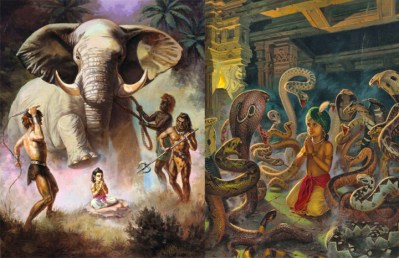
Brahma and HiranyakashipuThere once was a king, Hiranyakashipu, who became extremely powerful and nearly immortal due to a boon he received from Brahma, the creator god. He declared himself the supreme power in the universe and demanded the worship and reverence of the whole world. His son, Prahlad, was an ardent devotee of Lord Vishnu, the form of god representing Preservation of the universe. Hiranyakashipu hated Vishnu and tried his hardest to get Prahlad to admit that he, not Vishnu, was the Almighty. Despite years of indoctrination, Prahlad retained his love for the Lord, and his father thus deemed that he did not deserve to live.
Sending your own child to the God of Death is a violent tendency, certainly not laudable, regardless of your background.

Over the course of several weeks, Hiranyakashipu tried to kill his son in dozens of ways: he had his soldiers attack him with swords and spears, throw him off a cliff, starve him for days, poison him, and throw him to the bottom of the sea, but nothing worked.

prahlad-maharaj-demons.jpg

Nothing could hurt Prahlad.

Then, Hiranyakashipu came upon an idea. His sister, Holika, had received a boon from Brahma making her immune to fire. She volunteered to hold Prahlad in her lap and sit in a huge bonfire; he would burn and she would remain unharmed.

That’s not what happened. You see, there was actually a stipulation in Holika’s boon – she could only use it for self-defense, and if she used it to harm another person, it would not work. Thus, she burned, and through his unshakeable faith in the Lord, Prahlad remained unburned.

Thus, when Holi is celebrated, effigies of Holika are often burned.

We return to Sonalee’s claim: Holi perpetuates casteism.

Her argument revolves around the idea that Holika was an oppressed Dalit, and that these bonfires thus celebrate the burning of Dalits.

The father of Hiranyakashipu and Holika was Kashyapa, a revered Vedic sage of Hinduism and one of the saptarishis (seven sages), the saints most revered by Hindus. He would be classified as a Brahmin due to his involvement with the Vedas and his study of Divine knowledge.

Kashyapa_muni_statue_in_Andhra_Pradesh
A statue of Kashyapa Rishi in Andhra Pradesh.

Hiranyakashipu, Holika, and Prahlad, as royalty (Hiranyakashipu was the king) would classify as Kshatriyas.

Holika, a Kshatriya woman, died not because she was a Dalit, but because she attempted to kill a ten-year-old boy in cold blood by burning him alive. Her death is celebrated because she was trying to murder a small child!


Contrary to Sonalee’s claims, Holika and her brother opposed Prahlad precisely because of his universal, egalitarian teachings. There is an entire Hindu scripture is named after Narasimha, the incarnation of Vishnu that saves Prahlad from being murdered. In this scripture, the Narasimha Purana, Prahlad ends his sermon to his fellow students with this teaching: “I shall tell you a supreme secret. It is none other than Lord Vishnu who resides within each and everyone. Therefore, treat every creature as a friend.” (Narasimha Purana 43.15).

Where, exactly, is the casteism in celebrating Prahlad’s survival?

The Ramayana, an epic poem of Hinduism, tells the story of Ram, an incarnation of Lord Vishnu, in his quest to save his wife, Sita, from the clutches of Ravan, the king of Lanka.

featured-4-970x582The ten-headed Ravan was a passionate follower of Lord Shiva, the form of God representing destruction and renewal (just as Vishnu represents preservation), and he had also dedicated his life to pursuing art, music, and Vedic knowledge. Despite this, Ravan committed many evil acts throughout his life – not the least of which is kidnapping Sita to become his wife. Eventually, Ram was forced to kill Ravan despite giving him a number of chances to return Sita and escape with his life.

We celebrate the return of Rama and Sita to their kingdom with the festival of lights, Diwali. In her diatribe, Sonalee asserts that Ravan was a Dalit king, a true hero who is unfairly vilified.

Ravan’s grandfather was the sage Pulastya, one of the sons of Brahma and another of the saptarishis. Depending on how you look at it, he was either a Brahmin (due to his academic study) or a Kshatriya (due to his status as a ruler).

In most versions of the story, Ram had to atone for  Brahmanicide after having killed Ravan. In fact, Ravan has been a hallowed Brahmin name in South India for a long time. For example, a scholar named ‘Ravan’ wrote a commentary on the Rig Veda, and in the Ramayana, Ravan himself is described as a scholar of the Sama Veda. Ravana’s wife Mandodari was also of a royal lineage from Mandor in northwestern India. Until recently, the Rathore Rajput royalty of Jodhpur ruled from Mandor and continued to cremate their rulers there. This evidence hardly supports Sonalee’s claim that Ravan was a Dalit.

Arguably, Ravan was as Brahmanical as one can get!

In fact, if you look at the stories of Holika, Hiranyakashipu, and Ravan, they tell the tale of how one’s actions, not one’s birth or parentage, dictate one’s character. The Asuras (demons) and Suras (gods) share the same ancestry, but it is their choices that make them who they are. No matter how much penance or scholarship a person does, evil acts make them evil. And evil must be opposed.

Another story:

Mahishasura, an Asura or demon, received a boon from Brahma that no man could kill him. As he began to terrorize and persecute the gods and people of the earth, the gods came together to combine their essences, creating the goddess Durga, more powerful than any of them. It was Durga who was finally able to vanquish him and bring peace to the universe.

This story, celebrated each year through Durga Puja and Navaratri (‘nine nights’), actually strikes down patriarchy, establishing Hinduism as a faith which reveres the Divine as Goddess, who can vanquish powerful and evil men.

durga-maa2.jpg
Goddess Durga slaying Mahishasura.

Oddly, Mahishasura is held up as a Dalit hero, despite the fact that his people, the Asuras, share the same parentage as the Devas, or gods (lower case ‘g’).

I anticipate a rebuke to this perspective steeped in the discredited Aryan invasion theory of India. This theory, in brief, suggests that a race of foreign invaders (known as the Aryans) arrived in India thousands of years ago, established themselves as the ruling Brahmin caste, and began the subjugation of the indigenous Dravidian population that persists to this day.

Literary and geographic references within the Rig Veda (the oldest Hindu text), as well as extensive academic research, refute the timeline and the basis for this theory, suggesting that no such invasion, migration, or oppression took place.

Now, the next point Sonalee makes: colorism.

50-advanced-multi-vitamin-fairness-cream-fair-lovely-original-imaf7xy62b2wqnmg

It would be wrong of me to deny the presence of colorism in India (and, of course, the rest of the world). One look at the brand “Fair and Lovely” tells us quite a bit about the way we perceive skin color.

But to suggest that any evil characters in Hindu scripture are merely oppressed and misunderstood is to miss the point of the stories and ignore the history behind them.

Yes, Hiranyakashipu and Holika are, in many depictions, dark-skinned. But Kali, a form of the Mother Goddess, and Krishna, a beloved incarnation of Lord Vishnu, were also dark-skinned. In fact, Krishna is described as “dark as a thundercloud”.

Other prominent dark-skinned Hindu figures:

Arjun, a central character in the Mahabharata (the world’s longest epic) revered as a skilled archer, warrior, and brother. He is the recipient of Krishna’s teachings in the Bhagavad Gita.

Draupadi, the wife of Arjun and one of the strongest female characters in the Mahabharata. In fact, her given name is Krishnaa — “one with a dark complexion”.

Veda Vyasa, possibly the most revered sage in all of Hinduism. He wrote the Vedas (the most sacred texts) as well as the Mahabharata. In fact, the festival of Guru Purnima (a celebration of teachers) is dedicated to him.

Angirasa, a sage who is credited with a number of Vedic verses and is described as a teacher of Divine knowledge.

Lastly, narrative that the four Vedas are often manifested as the four dogs of the deity Dattatreya – two white dogs, and two black dogs!

download
Lord Krishna.

Where, exactly, is the anti-blackness in these stories?

We move on to another issue Sonalee highlights: misogyny.

One of the common ways that Holi is celebrated in India is through “playing Holi”, or mixing colored powders with water and tossing them at each other. Eventually, everyone is covered in multicolored (washable) dyes. This is a time when families, friends, neighborhoods, and communities come together to celebrate.

However, this does provide an opportunity for some of the more despicable men to harass women under the guise of playing Holi.

That being said, a law-and-order problem within the nation of India does not automatically require the culpability of an entire faith and its practices.

One argument I’ve heard: Holi might have been intended as a celebration of good over evil, but the way it manifests in practice is problematic, since people celebrating it oppress lower-caste people.

There are a couple of problems with this line of reasoning. Yes, I agree that Holi can be a time when Dalits are targeted — recently, there was a story of Dalits being attacked for putting color on a person of higher-caste.

Obviously, this is horrific. But it is not representative of Holi in theory or practice. Nor can we say that violence and bigotry is characteristic of Holi “in practice”. Hinduism is a religion of peace, tolerance, and respect. No one can expect an entire faith tradition or all of its practitioners to be held accountable for the actions of extremists committing violence in a religious setting; no one can expect this even when people cite religious texts to wrongly justify their violent acts.

Just as it would be unfair to blame Muslims for the recent vile attack in New Zealand, Christians for the horrific 2011 shootings in Norway, and Buddhists for the oppressive actions of the Myanmarese government, Hindus and Hinduism cannot be blamed for the crimes of individual people, regardless of the religious commitments of such individuals.

The actions of Daesh should not warrant a referendum on Muslims and their customs; the actions of the IRA should not warrant a referendum on Catholics and their customs; and the actions of anti-Dalit Hindus should not warrant a referendum on Hindus and their customs.

We return, at last, to Sonalee’s blanket claims about Hinduism: that it is violent and rooted in Brahmin supremacy.

Hinduism is a faith tradition going back thousands of years and is based in the idea that there are many paths to God – that no one has a right to judge the journey of another and that everyone is equally close to the Divine.

Of all the major faiths, Hinduism alone has shown no history of terrorism, religious wars, forcible conversions or persecution of ‘infidels’. Failing to find more than a handful of genuine examples in its 5000 year old history, ideologues like Sonalee start fabricating examples, as in this case.

Although Hindu ideals have been misused to promote political and economic agendas, the fact remains that Hinduism is one of the most inclusive faiths that exists worldwide, and to collectively hold its practitioners to standards to which no other religion is held is unfair and unjust.